

Explore top online quantum computing courses
What's the next wave in tech? Quantum computing has the power to transform technology — and you can start studying this emerging field today.
Key takeaways
- Quantum computers use the principles of quantum mechanics to solve problems more efficiently than traditional computers.
- Expand your knowledge of this emerging field with courses, certificates, and quantum computing programs.
- Studying quantum computing can lead to careers in computer science or build in-demand skills for your current field.
Popular online quantum computing courses with certificates




What is quantum computing?
Quantum computing is an emerging field within computer science that uses the principles of quantum mechanics to solve complex problems quickly. It utilizes qubits, or quantum bits, that can exist in multiple states simultaneously, enabling parallel computations and efficient problem-solving.
Quantum computing uses the unique behavior of quantum particles to perform many mathematical calculations at once. Quantum computers can solve problems more quickly and efficiently than traditional computers.
Why learn quantum computing?
- Get ahead of the curve and prepare for the next wave of quantum-driven computing careers.
- Expand your knowledge of algorithms, machine learning, and applied computing techniques, strengthening high-demand skills.
- Learn how quantum computing will transform fields like renewable energy, finance, medical research, and technology.
Browse quantum computing courses
Browse online Quantum Computing certificates
Find new interests and advance your career opportunities
Stand out in your field
Use the knowledge and skills you have gained to drive impact at work and grow your career.
Learn at your own pace
On your computer, tablet or phone, online courses make learning flexible to fit your busy life.
Earn a valuable credential
Showcase your key skills and valuable knowledge.
Certificates






How does quantum computing technology work?
To understand how quantum computing technology works, you must know how a traditional computer works. Your computer's central processing unit contains billions of transistors. Each transistor is a binary switch that can be off or on, creating a bit of information in the form of a 0 or a 1.
Although more transistors make a more powerful computer, their binary nature creates a speed bottleneck. Quantum transistors solve this problem by allowing for superposition, the concept that matter can exist in multiple states at once. Transistors can simultaneously exist as on and off or as 0 and 1. Key advantages include a massive increase in processing power with a fraction of the transistors.
Key principles of quantum mechanics
Before starting a quantum computing course, review the four key principles of quantum mechanics that have inspired this groundbreaking technology.
- Superposition: Quantum superposition states that matter acts like a wave at the subatomic level. Waves can combine and create new things, meaning that what is observed at a particular instant may not be the same thing that existed the instant before or after.
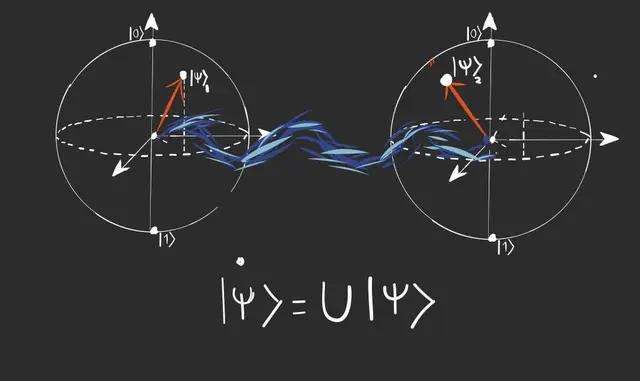
- Entanglement: Quantum entanglement is when two subatomic particles become linked. No matter how far apart these particles drift from one another, they will always act the same way.
- Decoherence: Quantum decoherence is when a subatomic particle loses its superposition. While a coin flipping in the air has superposition because it is heads and tails simultaneously, it becomes decoherent once it lands because it must be heads or tails.
- Interference: Superimposed subatomic particles create interference when their waves interact. This interference affects the chances of different outcomes, such as how a subatomic particle will travel.
Careers you can pursue with a quantum computing background
Quantum computing jobs continue to evolve as quantum technology advances, though the majority of roles require at least a bachelor's degree in a relevant field.
Below, find a few roles that use quantum computing, with required education information and salary data from the Bureau of Labor Statistics (BLS):
Computer and information research scientist
Many computer and information research scientists study quantum theory and conduct experiments to find solutions to problems. They may work for large corporations or the local, state, and federal governments.
- Required education: Master's degree in computer science, computer and information technology, computer engineering, or a related field; some employers may also require a doctorate
- Median annual salary (2025): $140,300
Computer and information research scientist
Many computer and information research scientists study quantum theory and conduct experiments to find solutions to problems. They may work for large corporations or the local, state, and federal governments.
- Required education: Master's degree in computer science, computer and information technology, computer engineering, or a related field; some employers may also require a doctorate
- Median annual salary (2025): $140,300
Why learn quantum computing online with edX
edX helps learners around the world grow their skills and careers. Join our learning community today!
Trusted by leading institutions





How to get started in quantum computing
Are you fascinated by the promise of quantum computing? You can get started in this emerging field by learning quantum computing online with edX.
1. Make a learning plan
Consider why you want to learn quantum computing. Perform self-reflection to discover your motivations. If quantum computing is a general interest subject or a potential hobby, you may not need an undergraduate or graduate degree.
To qualify for an entry-level job, you'll need many years of schooling. Research programs to get a general idea of how long you need to study. Most master's degrees take 12-36 months to earn on top of four years to complete a bachelor's degree program. Doctoral programs require an additional 4-8 years.
Once you know what you want to do with your education, make a plan. Leave yourself some wiggle room if unexpected events require you to pause your studies.
Featured courses


1. Make a learning plan
Consider why you want to learn quantum computing. Perform self-reflection to discover your motivations. If quantum computing is a general interest subject or a potential hobby, you may not need an undergraduate or graduate degree.
To qualify for an entry-level job, you'll need many years of schooling. Research programs to get a general idea of how long you need to study. Most master's degrees take 12-36 months to earn on top of four years to complete a bachelor's degree program. Doctoral programs require an additional 4-8 years.
Once you know what you want to do with your education, make a plan. Leave yourself some wiggle room if unexpected events require you to pause your studies.
Featured courses
How to choose the best quantum computing program for you
What's the best path to learn quantum computing? Discover more about the program types, timelines, and what you can learn below.